As we move through 2026, the global real estate landscape has become increasingly volatile. Investors are no longer just looking for "numbers on a spreadsheet"; they are looking for resilience, lifestyle, and regulatory fairness. Thailand has emerged as a standout performer. While other markets have hiked taxes on foreign buyers, Thailand has maintained a welcoming "equal playing field" policy that treats international investors with the same respect as locals. Whether you are eyeing a skyscraper in Bangkok or a tropical villa in Phuket, here is why the Thai property market is the ultimate "lifestyle hedge" for 2026.
1. The "Equal Playing Field": Regulatory Parity
One of the most significant barriers to international investment is often the "foreigner tax"—a surcharge or restrictive regulation designed to keep outsiders at a distance. Thailand flips this script.
Parity in Regulation: In the eyes of the Thai Land Department and Revenue Department, foreigners and locals are largely treated as equals regarding property taxes. There is no "additional stamp duty" for foreigners like you find in Singapore or Australia.
Legal Certainty: While land ownership has specific rules (Leasehold vs. Freehold Condos), the transactional process is identical. This transparency reduces the "risk premium" often associated with emerging markets.
2. The Favorable Tax Environment: Keeping Your Gains
In 2026, "tax efficiency" is the name of the game. Thailand remains one of the most tax-friendly jurisdictions for real estate in Southeast Asia.
No Specific Capital Gains Tax: Unlike many Western nations that take a massive slice of your profit when you sell, Thailand does not have a separate, stand-alone "Capital Gains Tax." Instead, a small "Withholding Tax" (calculated on a sliding scale based on the government's appraised value) is deducted at the time of sale.
Low Entry/Exit Costs: The Stamp Duty is a remarkably low 0.5%. Even if you are subject to the Special Business Tax (3.3%) (applicable if you sell within five years), the total closing costs in Thailand remain some of the lowest in the world.
3. The Lifestyle Pivot: From "Flip" to "Home"
The biggest shift we’ve seen in 2026 is the motivation behind the purchase. Investors are no longer "speculating" on quick flips; they are investing in their future quality of life.
The Second Home Appeal: With the widespread adoption of the Long-Term Resident (LTR) and Destination Thailand Visa (DTV), expats are viewing Thailand as a permanent or semi-permanent base.
Quality of Life: Your dollar simply goes further here. High-end condos that would cost $2 million in London or New York can be found in Bangkok for $400,000—complete with rooftop infinity pools, 24/7 concierge services, and world-class gyms.
4. Generating Local Income: The "Living on Yield" Strategy
A key benefit mentioned by seasoned investors is the ability to generate local THB income. If you own a property in Thailand and rent it out, that income can stay in a Thai bank account to cover your local living expenses. This eliminates the need to constantly move funds from abroad, saving you from fluctuating exchange rates and international transfer fees. In 2026, many retirees live entirely off the rental yield of their Thai portfolio while their main savings remain untouched back home.
5. Regional Deep Dive: Where to Buy in 2026?
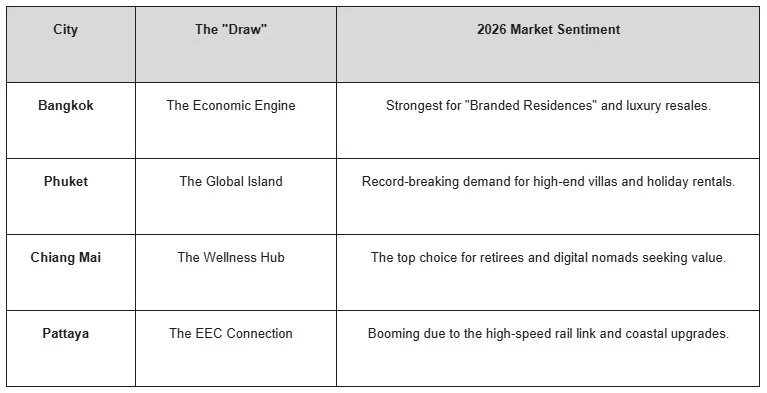
Bangkok: The Capital of Convenience
Bangkok remains the top choice for those who value infrastructure. The massive expansion of the MRT and BTS lines into the suburbs has opened up new "value pockets" where high-yield rentals are booming.
Phuket: The International Sanctuary
Phuket is no longer just a "vacation spot." It has become a global village. With international schools and world-class hospitals, the "Mooban" (gated community) lifestyle here is the most sought-after by European and Asian families alike.
Chiang Mai: Culture and Value
For those who want a slower pace and cooler mountain air, Chiang Mai offers the best price-per-square-meter in the country. It’s the "intellectual capital" of the expat community.
Pattaya: The Coastal Renaissance
Pattaya has reinvented itself. As part of the Eastern Economic Corridor (EEC), it’s attracting massive industrial investment, making it a hotbed for executive rentals and luxury beachfront living.
The 2026 Checklist
If you are considering an investment this year, keep these four "Khun Oh" inspired rules in mind:
Buy for Space: Prioritize larger layouts (80sqm+ for 2-beds) as they hold value better.
Verify the Quota: Ensure the unit is in the Foreign Freehold Quota for maximum security.
Think Long-Term: View the property as a "Second Home" first and an investment second.
Leverage Local Yield: Use your rental income to fund your Thai lifestyle.
Thailand in 2026 isn't just a place to stay—it’s a place to thrive. By balancing the favorable tax environment with the incredible lifestyle on offer, you aren't just buying real estate; you're buying peace of mind.
Are you leaning toward the urban energy of a Bangkok condo, or does the idea of a private pool villa in Phuket align more with your long-term goals?