For many expats, the dream of owning a piece of "The Land of Smiles" is met with a hard legal reality: Foreigners cannot directly own land in Thailand. While condominiums offer a straightforward freehold path, those dreaming of a villa, a garden, or a beachfront house must turn to the Leasehold structure. In 2026, as the Thai government tightens regulations on "proxy" ownership via companies, the 30-year leasehold has emerged as the most transparent and legally sound method for foreigners to secure landed property.
However, a leasehold is only as strong as the contract it's built on. Here is everything you need to know to ensure your investment is protected for the long haul.
1. The Structure: The "Prepaid" 30-Year Lease
In a standard residential leasehold, you aren't just "renting" a house month-to-month. You are essentially purchasing the right to use the land for a specified period.
The Term: Under Thai Civil and Commercial Code, the maximum term for a residential lease is 30 years.
The Payment: Most developers and landlords require a lump-sum payment upfront, effectively "buying" the lease for the full 30-year duration.
The Rights: A well-drafted lease gives you almost all the rights of an owner—you can live there, renovate, and in many cases, sell (assign) the remaining years of the lease to someone else.
2. The 3-Year Trap: Why Registration is Mandatory
One of the most dangerous mistakes a foreigner can make is failing to register their lease at the Provincial Land Office.
According to Thai law, any lease agreement for a period longer than three years must be registered on the back of the Title Deed (Chanote).
What happens if you don't register?
If you sign a 30-year contract in a private office but never take it to the Land Office, the law only recognizes your rights for the first 3 years. After that, the contract becomes "unenforceable" in a Thai court.
Why registration protects you:
Ownership Changes: If the landlord sells the land to a third party, a registered lease remains attached to the land. The new owner must honor your 30-year term. An unregistered lease, however, can be terminated by the new owner after the 3-year mark.
Government Proof: You receive an official document from the Thai government confirming your rights, making it nearly impossible for a landlord to contest your residency.
3. The Myth of "Automatic" Renewals
You will often see marketing materials for "90-year leases" (30+30+30). In reality, there is no such thing as a 90-year lease in Thailand.
The law is clear: a lease is capped at 30 years. Any clause stating that the lease "automatically renews" for another 30 years is not legally binding on the Land Office.
The Reality Check: A renewal is a "contractual promise" between you and the landlord. When the first 30 years expire, you must both return to the Land Office to register a new 30-year term. If the original landlord has passed away or the company has dissolved, enforcing that "promise" can become a legal nightmare.
Pro-Tip for 2026: If you are banking on a renewal, ensure your contract includes "Succession Clauses" that bind the landlord’s heirs or successors to honor the renewal promise.
4. Why Your Lease Contract Needs a "Precision Strike"
A leasehold is a private contract, which means the details matter. Many expats sign "standard" agreements provided by developers, only to realize later they are restricted in how they use the property.
To protect your investment, your lawyer must ensure the following are clearly defined:
Right to Sublease: Can you rent the property out to someone else if you leave Thailand?
Right to Assign: Can you "sell" the remaining years of your lease to a new buyer?
Maintenance & Taxes: Who pays the "Land and Building Tax"? (Usually the lessee).
Permitted Use: If you plan to run a small home office or a business, the contract must explicitly allow it. If the contract says "Residential Use Only," the landlord can technically terminate the lease if they catch you running a business.
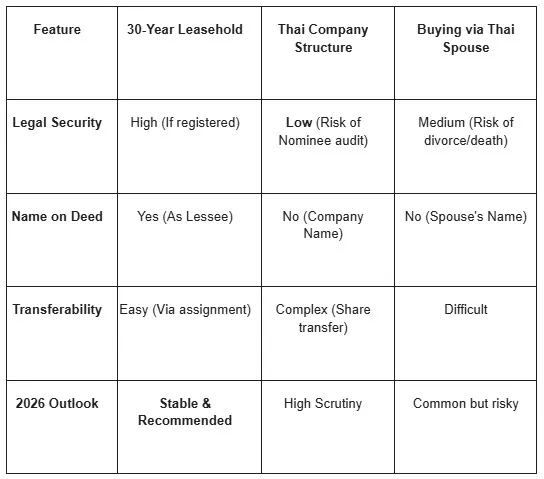
5. Comparison: Leasehold vs. Other Methods
The Final Verdict: Is Leasehold Right for You?
In 2026, the 30-year leasehold remains the "cleanest" way to live on land in Thailand without falling into the "nominee company" trap. It offers a predictable timeframe and strong legal protection, provided you follow the golden rule: Register it at the Land Office.
If you are looking for a "forever home" that lasts 50+ years, a leasehold requires a very trustworthy landlord and a very expensive lawyer. But for a 30-year lifestyle investment, it is hard to beat for simplicity and security.
Are you planning to lease from a major developer or a private individual? The "due diligence" process changes significantly depending on who is holding the other end of that contract.