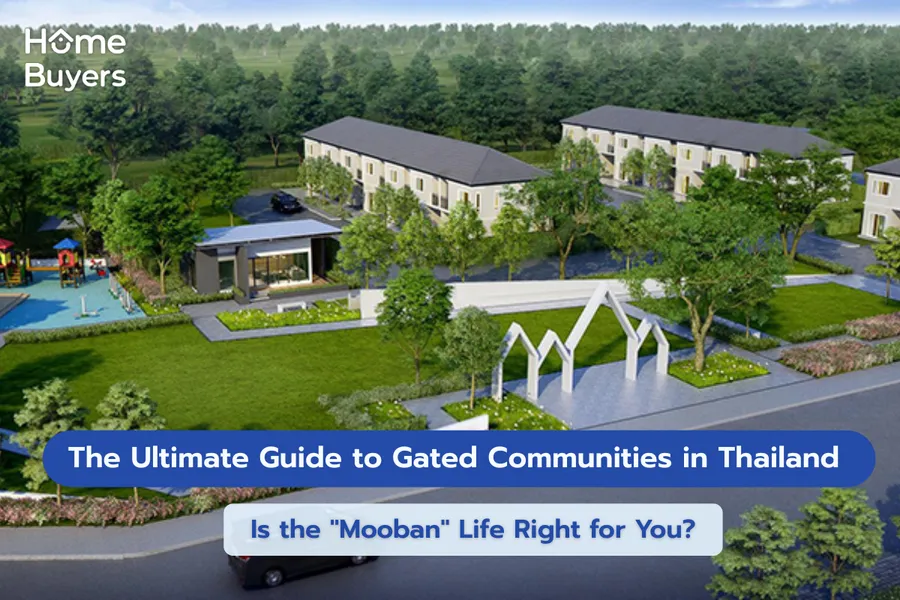
For many expats moving to the "Land of Smiles," the dream often involves a tropical villa with a private pool or a sleek high-rise condo. However, there is a third, incredibly popular option that defines middle and upper-class living in Thailand: the Gated Community, locally known as a "Mooban"
Whether you are looking at the sprawling suburbs of Bangkok, the lush hills of Chiang Mai, or the coastal reaches of Phuket, understanding the Mooban ecosystem is essential. This guide explores the lifestyle, the financial commitment, and the legal realities of living behind the gates in Thailand.
What is a "Mooban" exactly?
In the Thai context, a Mooban is a private housing estate developed by a single company. These estates range from modest clusters of townhomes to "ultra-luxury" developments where houses start at $1 million USD.
Unlike a standalone house on a public street, a Mooban is a managed environment. It is governed by a Juristic Person (similar to a Homeowners Association or HOA), which is responsible for everything from trash collection to maintaining the communal gardens.
The Pros: Why Expats Choose the Gated Life
1. Enhanced Security and Peace of Mind
Security is arguably the #1 reason foreigners choose Moobans. Most gated communities feature:
24/7 Guarded Entry: Security guards (RPH) monitor everyone entering and exiting. Visitors often have to exchange their ID cards for a visitor pass.
CCTV Surveillance: Common areas and entry points are usually under constant camera watch.
Controlled Traffic: Because the roads are private, you don't have to worry about through-traffic, heavy trucks, or reckless speeding, making it much safer for children to play outside.
2. Resort-Style Amenities
High-end Moobans are designed to feel like a permanent vacation. Depending on the "grade" of the community, you might have access to:
A Clubhouse with a large swimming pool and a modern gym.
Co-working spaces and libraries.
Manicured parks, jogging tracks, and playgrounds.
On-site convenience stores or cafes.
3. Infrastructure and Maintenance
In a standard Thai neighborhood, infrastructure can be hit-or-miss. In a Mooban, the developer ensures that:
Roads are paved and well-lit.
The drainage system is modern (reducing the risk of localized flooding during monsoon season).
The "visual clutter" of overhead power lines is often minimized or buried in luxury estates.
4. A Ready-Made Social Circle
For expats, Moobans offer an instant community. Many estates have active Line or WhatsApp groups where neighbors share information, recommend handymen, or organize social gatherings. It provides a "soft landing" for those new to the country.
The Cons: The Trade-offs of Living in a "Bubble"
1. The "Common Fee" (Kha Suan Klang)
The manicured lawns and security guards come at a price. Every homeowner must pay a monthly or annual common fee.
The Cost: This is usually calculated per square wah (a Thai unit of land measurement). For a standard house, you might pay between ฿2,000 and ฿10,000 per month.
The Risk: If the Juristic Person is poorly managed or if many neighbors refuse to pay, the community's facilities can quickly fall into disrepair.
2. Loss of Autonomy and Strict Rules
Gated communities are governed by bylaws that can feel restrictive to some:
Renovation Restrictions: You may need permission to change your house color, add a fence, or build an extension.
Parking Wars: Many Moobans have strict rules against parking on the street to keep the roads clear.
Business Bans: Generally, you cannot run a commercial business (like a loud workshop or a retail shop) out of your home in a Mooban.
3. The "Suburbia" Location
Because they require large plots of land, most Moobans are located on the outskirts of the city.
The Commute: If you live in a Bangkok Mooban but work in the city center (Sukhumvit/Sathorn), be prepared for a 60-90 minute commute in heavy traffic.
Car Dependency: Unlike living in a city condo, you will almost certainly need a car or a motorbike to get groceries or reach the nearest BTS/MRT station.
4. Lack of "Authentic" Thai Vibe
Some expats find Moobans to be "sterile." You lose the vibrant street life—the food carts, the local "Mom and Pop" shops, and the organic chaos that makes Thailand unique. Inside the gates, every house looks similar, and the atmosphere can feel somewhat isolated from the local culture.
The Legal Reality: Can Foreigners Own a House in a Mooban?
This is the most critical hurdle for any expat. Under Thai law, foreigners cannot own land in their own name. However, there are three common ways foreigners live in these communities:
Leasehold: You "buy" the house but lease the land from the developer (usually a 30-year lease, sometimes with options to renew).
Thai Limited Company: Historically, some foreigners have used a Thai company to hold the land. However, the Thai government has become much stricter regarding "nominee" shareholders, so this requires expert legal counsel.
Marriage: If you have a Thai spouse, the house and land are put in their name.
Usufruct/Habitation Rights: Legal agreements that allow you to live on the land for life, even if you don't own it.