Thailand remains one of the most attractive real estate markets in Southeast Asia for international investors and expats. Whether you are looking for a retirement nest in Chiang Mai, a holiday villa in Phuket, or a high-yield investment in the heart of Bangkok, the Condominium is the most secure asset class available to non-Thais.
Unlike landed property, which involves complex leasehold structures, the Thai Condominium Act allows foreigners to own the freehold title of a unit in their own name. However, this "Absolute Ownership" is contingent on two non-negotiable legal pillars. In 2026, as the Land Department increases digital oversight, understanding these requirements is more critical than ever.
1. The Foreign Ownership Quota The 49% Rule
The first hurdle in purchasing a Thai condo is the Foreign Quota. By law, foreigners can own no more than 49% of the total livable area of any single condominium building. The remaining 51% must be owned by Thai nationals or Thai entities.
Why Due Diligence is Mandatory
Before you place a reservation deposit, you must confirm that the "Foreign Quota" for that specific building has not been exhausted.
New Developments: Developers usually keep a strict tally. In high-demand areas like Thonglor or Central Phuket, the foreign quota often sells out during the "Pre-sale" phase.
Resale Units: If you are buying from another foreigner, the quota simply transfers to you. However, if you are buying from a Thai owner, you must ensure there is "space" left in the 49% pool to move that unit into the foreign quota.
Pro Tip: Always have your real estate agent or legal counsel obtain a written confirmation from the Condominium Juristic Person (CJP) verifying the current quota status before signing the Sale and Purchase Agreement (SPA).
2. The Financial Trail: International Transfer & The FET Form
The second pillar of foreign ownership is the Financial Requirement. To register a condo in a foreigner's name, the Land Office requires proof that the funds used for the purchase originated from outside Thailand.
The Mechanics of the Transfer
To comply with the law, you must follow a specific banking protocol:
Transfer from Abroad: The full purchase price must be sent from a bank account outside Thailand.
Foreign Currency: The funds must arrive in Thailand in a foreign currency (e.g., USD, EUR, GBP, AUD). Do not convert the money to Thai Baht before sending it; let the receiving Thai bank perform the conversion.
Specific Purpose: When initiating the transfer, the "Instruction to Beneficiary" or "Purpose of Remittance" must clearly state: "For the purchase of a condominium: [Project Name], [Unit Number]."
The FET Form (Foreign Exchange Transaction)
Once the funds arrive, the receiving Thai bank will issue a Foreign Exchange Transaction (FET) form (formerly known as Thor Tor 3). This document is the single most important piece of paper in your transaction. It serves as the official government proof that you have brought foreign currency into the country specifically for real estate investment.
Note: If the transfer amount is less than $50,000 USD, the bank may not automatically issue an FET. In these cases, you must request a "Credit Note" or "Bank Certificate" which serves the same legal purpose at the Land Office.
3. The Role of the Professional: Real Estate Agents and Counsel
While the legal requirements are clear, the administrative execution can be daunting for those unfamiliar with Thai bureaucracy. This is where a professional real estate agent becomes invaluable.
What an Agent Handles for You:
Quota Verification: They perform the initial check on building quotas.
Banking Coordination: They ensure the Thai bank issues the correct FET documentation with the proper wording.
Land Office Representation: The process of "Transfer of Ownership" happens at the local Land Office. An agent coordinates the appointment, prepares the forms in Thai, and ensures the title deed (Chanote) is correctly issued in your name.
No Extra Cost: In the Thai market, the seller typically pays the agent's commission. As a buyer, you receive professional guidance and due diligence at zero additional cost.
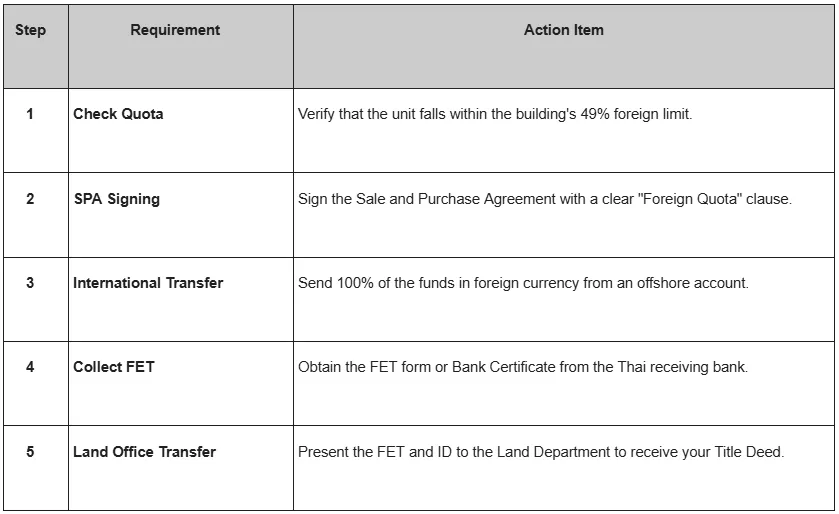
2026 Buyer's Checklist: A Summary
Conclusion
Buying a condo in Thailand is a straightforward process compared to many other international markets, provided you respect the Foreign Quota and the Financial Transfer rules. By following these two pillars, you ensure that your investment is 100% legal, protected by the Thai government, and easily transferable in the future.
In the 2026 market, where "Lifestyle Investing" is the primary driver, securing a freehold asset with a clear title is the smartest way to enjoy the beauty and economic growth of the Kingdom.